
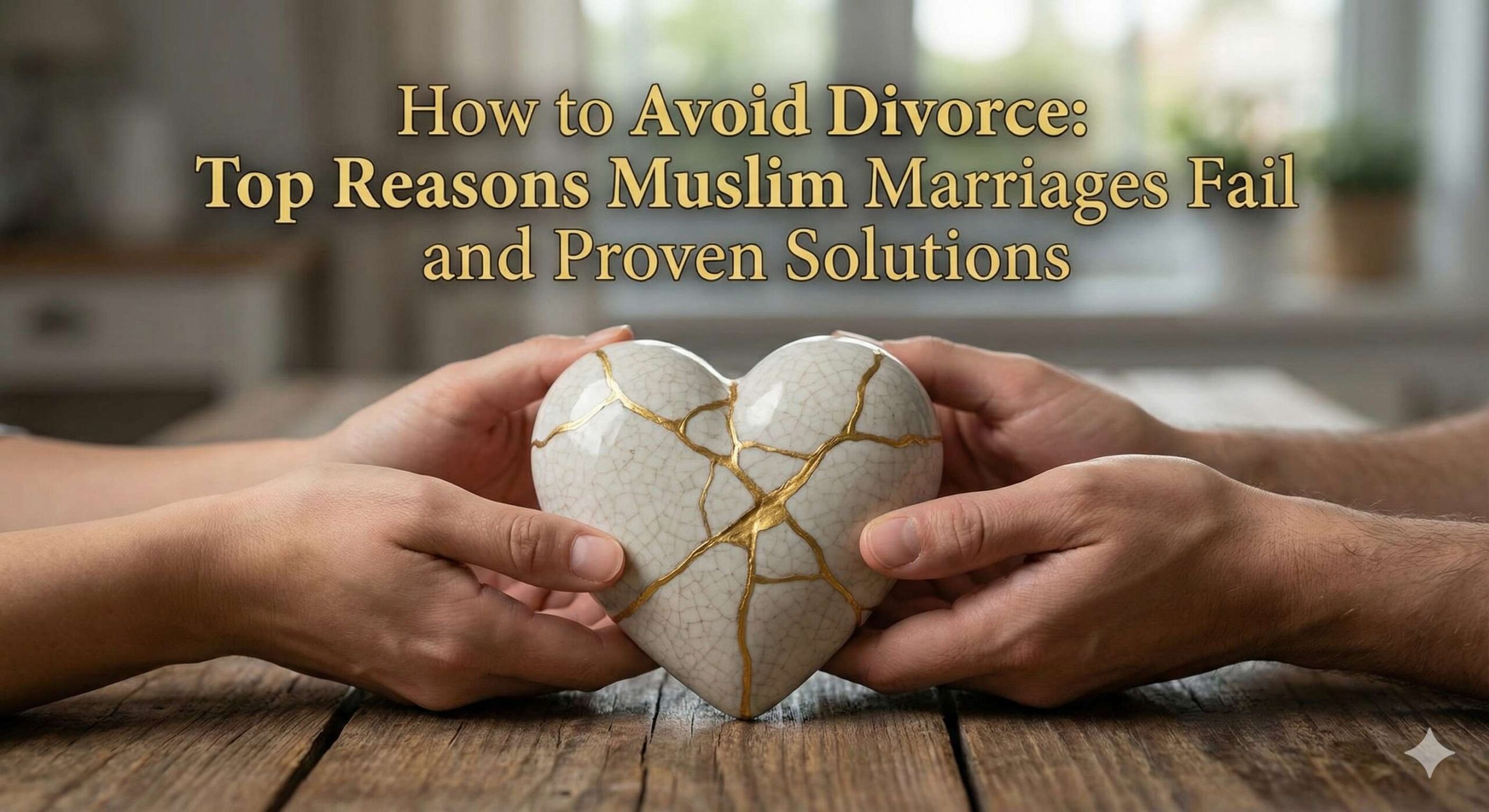
Why Do So Many Muslim Marriages in Sydney End in Divorce?
After years of counseling couples across Sydney, from Bankstown to Liverpool, from Parramatta to Lakemba, I’ve witnessed the devastating impact of divorce: grief, depression, stress, children caught in the crossfire, lost focus, and financial ruin. As Bilal Dannoun, a Sydney-based Muslim marriage celebrant specializing in Sharia-compliant nikah ceremonies and Islamic counselling, I see grown men crying in my office. I see individuals facing hardships that could have been prevented.
Divorce comes with serious ramifications. We really need to ensure our marriages are optimal so we don’t become part of the sad statistics. Today, I want to share the top reasons why Muslims and non-Muslims find themselves on the track toward divorce, and more importantly, what we can do to safeguard ourselves and our families.
The good news? Most of these problems can be prevented with the right knowledge, commitment, and connection to Allah. Let me share what I’ve learned from thousands of counseling sessions across Greater Sydney.
Before Marriage: The Foundation of Success
1. Due Diligence and Istikhara
For Singles: Before you even say “I do,” you need to ensure two critical things have happened:
Due Diligence: You must ask all the right questions to your proposed spouse. You need to investigate their character, their family background, their vision for life. Make sure you’re compatible, that you share the same vision.
Real-Life Example: Today I was counseling a brother unsure whether to proceed with marriage. The main question centered on whether his future wife would work once they have children. He had that conversation with her, but she hasn’t given him a straightforward answer. That’s not good because it creates uncertainty and gives the impression that this is negotiable.
If this is something you don’t want, communicate it now. Later on, there shouldn’t be “she said” or “he said” or “you didn’t tell me.”
Critical Questions to Ask Before Marriage:
- What are your expectations about working (especially for women after children)?
- What are the roles of the wife?
- What are the roles of the husband?
- How do you envision parenting?
- What are your financial expectations?
- What are your boundaries?
- What are your insecurities?
- What are your needs?
Be transparent. Don’t be someone who’s just going to “wing it” later on. It’s better to communicate your expectations, your values, and your needs before marriage.
Istikhara: After due diligence, reach out to Allah and do your istikhara. Make dua and ask: “Ya Allah, if there is goodness in this, make it happen. If it’s not good for me, drive me away from it, distance it from me, and give me better.”
This means you have full tawakkul (trust) in Allah. There’s no room for emotions here. Put your emotions to the side, especially before marriage. Put the good looks to the side. Put all that to the side. You need to have that conversation, otherwise you may end up marrying someone you’re going to have problems with.
Quote from Bilal Dannoun: “From the very beginning, before marriage, it’s crucial to communicate what you want and don’t want. Make it clear: I don’t like this, I like this, I have insecurities here. Otherwise, you may end up marrying a person you will have serious problems with.”
Top Reasons for Divorce and Their Solutions
Reason #1: Disconnection from Allah and Living in Sin
The Problem: At the end of the day, Allah is in control of hearts. Allah is in control of your spouse’s heart.
The Quranic Warning: “Whatever misfortune befalls you is due to what your own hands have earned, and He pardons much” (Surah Ash-Shura, 42:30).
It’s really important that you keep away from sins, that you are fulfilling Allah’s commands. Allah says: “Those who believe and do righteous deeds, the Most Merciful will instill affection in the hearts of others towards you” (Surah Maryam, 19:96).
We need to make sure we are not compromising on anything that is haram so it doesn’t impact the marriage and relationship.
My First Question as a Counselor: “Tell me about your relationship with Allah. Tell me about your connection with Allah.”
If that’s not solid, we need to start with the foundation. If that’s not solid, it could be one of the greatest causes and reasons why there’s no barakah, no blessing, in your marriage.
Real-Life Story: I remember incidents where a couple had problems and called a sheikh over. The sheikh came to their newly-built home and asked, “How did you purchase such a beautiful home?” They replied, “Through the bank.” He said, “Assalamu alaikum,” and walked out.
He said, “Look, there’s no barakah in here. That’s probably one of the main reasons you’re going through what you’re going through in your marriage.” You don’t want to spoil the relationship with Allah. You want to make Allah your priority always. There’s no compromise on the deen of Allah.
The Quranic Connection: In Surah At-Talaq (the chapter about divorce), Allah mentions taqwa (God-consciousness) at least four times: “Whoever has taqwa, Allah will provide a way out of hardship and difficulty.”
Remarkably, in Surah Al-Baqarah, immediately after verses about divorce rules, Allah says: “Maintain your prayers, preserve your prayers, and in particular the middle prayer” (Surah Al-Baqarah, 2:238).
The commentators of the Quran said there must be a connection between divorce and your connection with Allah, because salah is the connection between you and Allah.
Action Steps:
- Make sure your wife is praying
- Make sure your husband is praying
- Make sure your money is from halal
- Don’t engage in haram
- As a husband, remember: Allah has made you the imam of the house. Even if a sheikh came to your house and you know how to lead the prayer, you have more right to lead the prayer in your home than the sheikh himself
The Command: Allah says, “O you who have believed, protect yourself and your family” (Surah At-Tahrim, 66:6). Your family here is your wife. You have a duty, I have a duty as a husband, to be the leader, to have leadership (not dictatorship).
You’re a leader, you’re an imam, and you lead by example. Remember the Prophet’s words: “Go easy on the fragile vessels.”
The Beautiful Saying: The pious predecessors used to say: “Repair your relationship with the Creator, and He will repair your relationship with the creation.”
Quote from Bilal Dannoun: “This is the first major thing I want all couples and potential couples to be mindful of: prioritizing Allah. When your heart is connected to Allah, the hearts remain connected with each other.”
Reason #2: Infidelity and Not Lowering the Gaze
The Problem: This is a very broad word in this day and age. Infidelity means cheating, and there are different levels and interpretations.
Forms of Infidelity:
- Full-fledged cheating (actual zina)
- Polygamy without proper handling (a husband marrying a second wife; to the first wife, “you’ve cheated on me”)
- Looking at inappropriate images (I know cases where couples divorced because the husband was addicted to inappropriate images)
- Not lowering the gaze
- Being on dating apps or dating websites
- Texting through social media with non-mahram individuals
- Befriending the opposite gender on social media
All of this falls under the broad heading of infidelity, of cheating, of not being loyal toward your spouse.
The Jealousy Factor: We have to be very careful, especially because women have a lot of jealousy. The jealousy that’s innate in a woman is natural for her to have. It’s important to be mindful of that.
Real-Life Example: I know a brother who went to a club with some boys, and they were dancing. About a year later, it showed up on his phone somehow through social media apps, anniversaries, or people sharing. His wife saw it and said, “Oh my God, I can’t believe you cheated on me. You were dancing with other women.”
The scenes are going to come back and haunt you, whether it’s from Bankstown, Auburn, or anywhere across Sydney. Be careful.
The Solution: Lower your gaze. Avoid inappropriate content. Set clear boundaries with the opposite gender. Be transparent about social media usage. Understand that trust, once broken, is very difficult to rebuild.
Reason #3: Lack of Anger Management and Emotional Intelligence
The Problem: Disrespect, not knowing how to contain your emotions, having a very short fuse, always exploding, not knowing how to handle disagreements.
This could be because:
- You’re very sensitive
- You have your own insecurities
- You only know how to disagree the way your father disagreed with your mother, your mother disagreed with your father. They are the template for disagreements for you
The Study: There was a study of 700 couples over 65 years old who had been married for over 30 years. Researchers wanted to know: what are the secrets?
The Finding: Those couples in healthy relationships were able to sit down and discuss an issue without shouting, without screaming, without disrespect. They were assertive, had standards, had boundaries, and discussed the situation calmly.
The Reality: There’s always going to be situations. We’re not meant to agree on everything. It’s not a problem that we have difference of opinion. The problem is that many of us are disrespectful when we have defensive opinions.
If You Have Issues: I recommend that you obsess and start working on your weakness. If it’s anger management issues, start to become a more emotionally intelligent human being. Know how to be diplomatic, respectful, not rude. You don’t have to shout to bring your point across.
That takes practice. That takes knowledge.
The Prophet’s Advice: When a man asked the Prophet (peace be upon him) three times, “Give me advice,” he said three times: “Do not get angry.” Anger is going to paralyze your thinking, and you’re not going to say or do the right things.
From the Story of Musa: “Then when the anger subsided, he took the tablets” (Surah Al-A’raf, 7:154). He was angry and about to do an action, but he waited for his anger to subside.
The Story of Ali and Fatimah: Ali (may Allah be pleased with him) and Fatimah, the daughter of the Prophet, had an altercation. What did Ali do? He left and went to the masjid.
The Prophet came over to their house and asked, “Where’s Ali? Where’s your cousin?” She said, “We had a fallout and he left.”
The Prophet went to find him. This teaches us that when you hear a couple has a problem, one of the best things you can do is try to help. Even if you don’t have the knowledge, you’re not a counselor, just say, “Hey, I heard you had a fallout with your wife. I’m here for you. Are you okay? Do you need anything?”
That’s Islam. That’s brotherhood. That’s loving for your brother what you love for yourself.
The Prophet found Ali sleeping in the masjid with dust on his clothes. He woke him saying, “Get up, O Father of Dust.”
Lessons from This Story:
- When you have a problem, you need to learn how to have time out from your partner so the situation doesn’t escalate
- You need to practice that and get good at it
- One of your go-to places when stressed should be the masjid
- Ali set that example, and the best rescue came: the Prophet (peace be upon him) himself
Unfortunately, I know many brothers and even sisters who, when stressed and anxious, go to drugs, gambling, or talk to the opposite gender. You need to be intentional about your go-to whenever you’re stressed out.
Establish Rules with Your Partner:
- “When we have a fight, what do the rules look like in our home?”
- “If either of us are angry, we’ll communicate: I’m angry and need to be left alone”
- “We both agree we’ll give each other space because if we don’t, this can escalate”
We want to ensure that the problem is the problem. You’re not the problem. I married you. If you were a problem, I wouldn’t have married you. You’re not the problem; the problem is the problem. We will have problems, and you will not see eye to eye on everything.
Recommended Reading: Correcting People’s Mistakes: The Methodology of the Prophet by Muhammad Salih Al-Munajjid. This is a really good book teaching how the Prophet (peace be upon him) defused many difficult situations through hikmah (wisdom).
Quote from Bilal Dannoun: “Ensure you have good anger management. You need to practice time out, establish rules, and be intentional about where you go when stressed. The masjid should be your refuge, not harmful places.”
Reason #4: Family Interference
The Problem: Families interfering with the marriage, with the life of their child. In-laws. This is another big one.
You could probably look up any scholar online and type “in-laws” and the scholar’s name, and you’ll probably find the best scholars talking about boundaries and how to deal with difficult in-laws.
Specific Issue: If you have a problem with your husband or wife, I would recommend NOT going to your family directly, to your mum or dad. That could be dangerous for the relationship.
Why It’s Dangerous:
- They end up controlling the situation
- They guilt-trip the child
- They use emotional blackmail
- It gets more personal
- They may already have had issues with their son-in-law or daughter-in-law
Better Approach: Go to somebody who’s neutral, who’s not going to take sides, who’s not emotionally connected, so the situation doesn’t escalate.
Family interference seems to be one of the reasons many marriages end up in divorce, because families get involved and the child doesn’t know how to handle it. They want to please their parents. They’re caught between a rock and a hard place.
If You Are a Parent: I would recommend that you always try and include a third party, an elder, a sheikh, somebody who has wisdom and insight, to ensure the best outcome.
For Couples Across Sydney: Whether you’re in Bankstown, Lakemba, Campbelltown, or Greenacre, when family wants to get involved, make sure there’s professional, neutral help involved first.
Reason #5: Unresolved Trauma
The Problem: Some of us have gone through issues in our younger years:
- Abusive parents
- Parents who abandoned us
- Parents who are divorced
- Parents who were quite toxic themselves
You take on many of their characteristics because they are your window to marriage and to how you handle conflict.
The Powerful Saying: “If you don’t heal what hurts you, you will bleed all over those who never cut you.”
If You’re Not Married Yet: My advice is to go and seek help through a sheikh, through a Muslim psychologist or counselor who understands human behavior, understands trauma, understands anxiety, and will help you unpack your problems in a way that ensures it doesn’t impact the marriage.
Where Trauma Shows Up: Most of the time, it shows up in the marriage once you get married. It shows up in your behavior. You might start causing injustice to your partner, or you cause injustice to yourself, or both.
Common Issues from Trauma:
- Anger issues (I see this in many couples I counsel)
- Separation anxiety
- Trust issues
- Control issues
- Insecurity
Action Step: Start to obsess. Be intentional about doing the work that needs to be done to ensure you’re going to be the best version of yourself as a husband, as a father, as a Muslim.
Check-In Baggage vs. Carry-On Baggage:
- Check-in baggage: Too heavy, too big. You haven’t sorted that out yet. Don’t bring this to your marriage.
- Carry-on baggage: Yeah, I’ve got some issues. I’m not perfect. I’m not an angel. Therefore, I’m going to have some problems, but I’m open to the idea of always working on myself because I want to be the best version of myself.
Special Issue: Narcissistic Personality Disorder (NPD)
I see this quite often. A narcissistic person:
- Lacks empathy
- Is very selfish
- Is not considerate
In psychology, they classify narcissists alongside psychopaths and sociopaths.
From an Islamic perspective, we know the hadith: “Love for others what you love for yourself.” We have a concept called ihsan, always helping others, being considerate, empathetic, sympathetic. That’s how we need to be as Muslims.
When we research narcissistic personality disorder, we see this has a lot to do with those in a state of nafs al-ammara (the soul commanding to sin). If you’re in that state, it could lead to narcissism and narcissistic behaviors.
The Prophet’s Mission: “I have been sent to perfect good moral character.” We need to ensure we have the best character toward our family members.
Quote from Bilal Dannoun: “Relatives and people around us are most deserving of our good treatment. We don’t give strangers the best of our treatment, love, mercy, affection, compassion, empathy, and sympathy, then come home and give our family members our scraps and leftovers. That’s not how it should be.”
Reason #6: Not Spending Quality Time Together
The Problem: Especially wives complain how husbands are not spending time with them.
The Story of Salman and Abu Dhar: Salman visited Abu Dhar and found that his wife had sort of neglected herself. Salman asked, “Why are you like this?” She said, “Your brother is not interested in me. He only wants to worship. He just wants to worship. That’s all he cares about.”
Salman stayed over. He got Abu Dhar to break his fast, to not pray all night, to go to sleep. Then he said to Abu Dhar: “Your Lord has rights, your body has rights, your family has rights. Give each their due right.”
When Abu Dhar mentioned this to the Prophet (peace be upon him), the Prophet said: “Salman has spoken the truth.”
The Lesson: This teaches us the concept of being disciplined. This teaches us the concept of being balanced as Muslims. It’s not just all worship and no fun or no time for the family. It’s not all fun and no worship. We have to find the balance.
Part of being a human being, we want to have some entertainment. Look at Islam: it’s not just salah. It’s also fasting. It’s not just fasting; it’s also hajj. It’s not just hajj; it’s also zakah. It’s not just acts of worship; it’s also laughter, it’s also halal entertainment.
Practical Example: Imagine your wife is at home all day with the children. The children can be challenging. She would love to have a cup of tea with you at the end of the night. Just being intentional about that, balancing your time, because that could lead to emotional connection.
The Emotional Connection Factor: Women find it very difficult to be physically connected with their husband if there’s no emotional connection.
When a husband comes complaining, “My wife doesn’t get intimate with me. She doesn’t give me my right,” straight away you can tell there’s more to the story than she just doesn’t want to fulfill the right. It’s about her feeling emotionally connected to you, and then the world becomes your oyster.
Important Distinction: We’re not talking about the black-and-white hadith about if she refuses and the angels curse her. We know that hadith. But we’re saying: why don’t you as a husband just get more connected to her? Listen to her. What does she want? She wants a bit of your time. Give her time.
What is it that’s going to make her feel emotionally connected? Do you really want to be intimate with your spouse in a way that she’s not into it? You want the experience to be good for both of you.
We-Time Moments: I call them “we-time moments” throughout the week. If you commit to those we-time moments with your wife, with your husband, what’s going to happen is that emotional connection and the physical connection become organic.
Quote from Bilal Dannoun: “Balance your time. Have quality we-time moments. Part of being human is wanting entertainment and connection. When emotional connection is strong, physical connection becomes natural and organic.”
Reason #7: Lack of Communication
The Problem: Lack of communication about:
- Your needs
- Your boundaries
- What you want and don’t want
There needs to be good communication throughout the relationship, especially from the very beginning, from the get-go.
What to Communicate:
- “I don’t like this. I like this.”
- “I have insecurities here.”
- Expectations
- Rules
- Roles in the marriage (who does what)
Part of the problem is many of us are not good communicators.
The Famous Incident: The Prophet (peace be upon him) before going to Arafat said: “Clarify to me so that I can learn from you.” He wanted to ensure that when he went to Arafat, he was delivering good speech so the speech was understood.
Common Issues:
- Miscommunication
- Communication that’s not very clear
- Room for interpretation
Do your best to communicate your message in the best possible way so there’s no misunderstanding.
Avoid Texting When Angry: If you’re having a dispute, do not do it through text. Communication is also body language and intonation.
I can say, “How are you?” Or I can say, “How ARE you?” See the difference? In text messages, you can’t see a lot of that. Avoid texting when you’re mad, when you’re angry. The message won’t be very clear or could be misinterpreted.
Reason #8: Bad Friends
The Proverbs: “Tell me who your friends are, and I will tell you who you are.” Or as the Arabic proverb goes, your companion will drag you, will pull you in this direction or that direction.
“Friends are like lifts. They can take you up or bring you down.”
Better Than All This: The words of the Prophet (peace be upon him): “A person is on the way, on the path, of his close friend.”
Real-Life Example: The brother I mentioned earlier who went to a club? His wife said, “He’s hanging out with these guys, and I’ve told him not to hang out with these guys.”
Likewise with sisters, sometimes they have bad friends. The husband says, “I don’t want you to spend time with this woman. I don’t want you talking to this woman.” He has the right to make this instruction.
The Reality: Friends can become very problematic and can lead to dysfunctional relationships and ultimately to divorce.
Reason #9: Comparing Your Relationship to Others
The Problem: You go on social media, see photos on Instagram, and they’re all photoshopped. Everyone’s always smiling. Everyone’s got their most beautiful shot, their most beautiful garments. You think they always look like that: picture-perfect family.
The Reality: It doesn’t always look like that. That’s not reality. That’s not the truth. Every single relationship has challenges. It’s how you manage that relationship.
Everyone’s going through something. Stop comparing your relationship to others. Had you been in that relationship, it could probably be a disaster.
The Solution: Accept what Allah has decreed for you. I’m not telling you to be a doormat or a pushover. You have standards, you have boundaries. But do not compare what’s going on with somebody else’s relationship. You don’t know the full story.
Warning About Second Wives: I had a couple recently come in. Things have been a little bit rocky for some time. What’s his solution? “I’m going to go and marry a second wife.”
Do you really think that’s a solution? Let’s stop for a moment. Do you really think that’s going to solve the problem for this woman, or is it going to create more anxiety? It actually creates more anxiety in her, and she started threatening divorce. That’s not the outcome we want, and there are children involved.
If You’re Going to Marry a Second Wife: If you’re going to do it, do it properly. Don’t do it hush-hush behind your wife’s back. Don’t be very secretive. Then she finds out through friends or through your phone. What happens? You’re either going to divorce the second wife, or you’re going to divorce the first wife, or you’re going to divorce both of them. That’s what we see happening.
Do things properly. Do things with wisdom. Don’t be a dodgy person. Be a decent human being that can be honest with your partner.
Quote from Bilal Dannoun: “Stop comparing your relationship to others on social media. That’s not reality. Everyone has challenges. Accept what Allah has decreed and work on your own marriage.”
Reason #10: Compounding Issues Not Being Addressed
The Problem: Too many issues haven’t been dealt with. They pile up.
The Solution: Identify your pain points in the relationship. What are you not happy about? Start discussing them, having a dialogue with your partner, so you can come to an amicable agreement, you can come to a solution, without letting all these issues pile up.
The Progression: Piling up issues leads to resentment. Resentment leads to rejection. You’re going to feel emotionally disconnected.
Quote from Bilal Dannoun: “These are some of the reasons I experience on a day-to-day basis with many couples coming in for counseling. May Allah keep all your relationships halal and healthy. May Allah drive away the Shaytan, because Shaytan knows that if he can separate between these two, he can cause collateral damage. It has a ripple effect on mental health, physical health, wealth, focus, worship, and children.”
Understanding Islamic Divorce: When It’s Necessary
Important Clarification: Divorce is not haram. Often, divorce is a solution to a problem.
Scholars say divorce is makruh (disliked) because of the implications and the ripple effect it has. But in some cases, divorce is the only solution.
Clarification About Divorced People: If a person is divorced, it doesn’t mean they are a bad person. Not necessarily. It just means:
- It didn’t work out
- They were not on the same page
- Perhaps they met when both were off the deen, then one got onto the deen and the other didn’t
- One person didn’t want to raise children in a relationship where there’s no deen
We have to be very careful with how we assess people who are divorced. We don’t know the whole entire story.
The Islamic Way to Divorce
When Contemplating Divorce:
- Never contemplate divorce when angry: There’s difference of opinion, but scholars say that anywhere between middle-range anger to high-level anger, divorce doesn’t take place. There’s a hadith: “There is no binding divorce when a person is in a state of ikrah (compulsion)” where the mind isn’t thinking straight, in a really perturbed, angry state.
- Never make a permanent decision from a temporary situation: Don’t weaponize divorce just because you’re angry. Don’t threaten with divorce between husband and wife. That’s not the right way.
- Talk it through when calm: Can we solve it? Can we talk? Can we bring in a third party? Can they arbitrate? Can we mediate? Exhaust every option first.
The Proper Islamic Divorce Process:
Requirements:
- She’s not in her period
- There has been no intimacy since her last period
- She’s in a state of purity (not menstruating)
The Process:
- You say to her once only: “You are divorced”
- She goes into her iddah (waiting period) of three menstrual cycles, regardless of how long each cycle is
- During this entire period, the husband has the right to take back his wife. He can say, “I’m sorry,” and everything is like before. They’re back together
- This applies to the first or second divorce
- If it’s the third divorce, he can’t go back to her until she remarries someone else, has intimacy with the new husband, they get divorced, then he can remarry her
About Triple Talaq: In some communities, especially Desi cultures (India, Pakistan), they do divorce three times in one go: “Divorce, divorce, divorce.”
There’s difference of opinion among scholars. During the time of Abu Bakr and the first two years of Umar, this was only considered one divorce. When people started not taking this matter seriously, Umar said, “That’s it. Three equals three.” He was the Khalifa.
But going back to the asl (original principle), during the Prophet’s time, it was only considered once.
About Khul’ (Woman Initiating Divorce): When the wife is initiating the divorce, saying to the husband, “I don’t want to be with you,” the husband can say, “I’m not divorcing you. Why should I be out of pocket in terms of the mahr?”
He asks, “Do you forfeit your mahr? Do you forfeit your dowry or part of your dowry?” She says, “Yes, I don’t want anything from you.”
Difference from Regular Divorce:
- Only one menstrual cycle or one month (if she doesn’t have her cycle)
- The husband can’t take her back during that month
- They have to redo their marriage contract
- It’s not counted as one of the three divorces
- If they go back to each other with a new contract, they still have three divorces available
About Pregnant Women: If a husband divorces his pregnant wife during pregnancy, that’s still a binding divorce. Her iddah is until she delivers the baby, whether it’s nine months or one hour after he says the divorce.
What Women Can Ask For in Islamic Divorce
Islamically Permissible:
- Her mahr (dowry) if he hasn’t paid it
- Any financial contributions she physically made from her own money to property, car, or assets (she’s entitled to her percentage)
Not Permissible: She can’t ask for 50% of his assets or 50% of the home unless that was agreed upon at the time of the marriage contract.
Warning: Women need to be very mindful about this particular point. If you want 50% of his assets or 50% of the home, say so at the time of the contract, and either he agrees or disagrees. But to come and ask for something that’s not Islamically yours and go down the route of the civil system, that’s oppression.
Quote from Bilal Dannoun: “You’re causing injustice to yourself and injustice to your husband by asking for what is not Islamically yours through the civil court system.”
The Role of Tests in Marriage
Sometimes you’re being tested, and that test is to wake you up. You have to ask yourself: “Am I doing something I shouldn’t be, or should I be doing something I’m not doing?”
Real-Life Example: I had a couple where the husband was seeing escorts. The wife discovered it on his iPad. They had a good relationship, but neither prayed.
We started talking, and I said to the sister, “Maybe you needed to go through this test to start praying. Isn’t it better that you found this out and you’re going through this test now, then you’re sitting in front of me and I’m telling you that you better start praying for the sake of Allah? Now you’ve got a chance to go to Jannah. Would you prefer to spend the rest of your life not praying and be on your way to Jahannam, or would you prefer to go through these tests and go to Jannah?”
She started praying after this calamity.
The Perspective: We have to look at it this way. It depends on a case-by-case scenario, but tests can be wake-up calls from Allah.
Practical Advice for Sydney Couples
Building Emotional Connection
For Husbands: It happens during the day through your respect. At the end of the day, what does every husband want? He wants to be respected.
You need to respect your man. You need to validate him. He works hard, he’s out laboring, trying, stressing out, really trying to make it work, trying to provide for you and the children. Just give him a word.
One of the best things you can do for a man:
- Show him you care
- A basic meal means a lot
- A basic message
- Sometimes dress up for him
That means a lot to a man. It makes him feel emotionally connected, that you actually acknowledge him and prioritize him. It’s not just the cooking and cleaning or just the children.
Priority: Recently I wrote a post: prioritize your spouse (husband or wife) more than you prioritize your children. If you don’t do that, your husband or wife’s not going to be happy, and your children are not going to be happy.
Organically, you’re going to look after your children. It’s going to happen organically. But there’s more effort required for your spouse.
For Wives: Be intentional about emotional connection before the intimate act during the day.
For the husband, it’s respect. For the wife, it’s love. It’s ensuring you’re working with her love language:
- What does she want? She wants time. Give her time.
- She likes surprises. Give her a gift.
- She wants you to help her out. Help her out.
When Aisha was asked what the Prophet did at home, she said, “He was at the service of his family members.”
The Importance of Knowledge
One of the best things you can do for your children (if you’ve missed the boat yourself) is make sure they really understand their role in a relationship as a husband or as a wife. What does that look like from:
- The Islamic lens
- Human behavior perspective
The Malaysian Success Story: In Malaysia in the early 90s, they looked at divorce statistics and saw they were sitting in the high 30%. Then the government made it mandatory to do a pre-marriage counseling course, or else you cannot get married.
Ten years later, the divorce statistic went down to under 10%.
The only thing that changed? Knowledge. Now people have the tools, the strategies. They know how to communicate. They know why their husband does what he’s doing. They know why they’re doing what they’re doing. They understand their issues: anger management, separation anxiety, and more.
Quote from Bilal Dannoun: “It’s about having that understanding on how to be as a husband, as a wife. One of the best things you can do if you’re about to get married or you’re married and struggling through a challenging marriage is to learn, to unlearn, and to relearn.”
My Online Marriage Course: Alhamdulillah, Allah blessed me to compile a marriage course consisting of 117 videos. They’re short videos that combine:
- The Islamic lens (looking at the Sirah of the Prophet and hadith about marriage)
- Modern-day research around human behavior and psychology
Integrating both ensures a happy marriage.
Common Questions About Marriage and Divorce
Q: Should I use hadith to correct my spouse?
Don’t be hypocritical and weaponize the hadith and ayat to prove a point. There should be a gentle dialogue between husband and wife. There needs to be gentleness.
Change your strategy. Is what you’re about to say going to make their hearts closer or more disconnected? That’s the question you have to ask. Is what I’m about to say right now going to make the situation better or worse?
Allah says: “Repel that which is negative with that which is better. You will see between the one you and them, there is enmity, you will be as if you are very close friends” (Surah Fussilat, 41:34).
The scholars said: if you’re not getting the desired result regarding your disputes and altercations, then you did not apply ihsan (excellence). You were not sincere, you were not using best practices, you were not using wisdom. Go back and check your methodology. How are you dealing with your husband, with your spouse, to correct the situation?
Q: Does a husband need permission from his first wife to marry a second wife?
The answer is: he does not need permission. But is it wise? Is it really wise that you’re just going to go and do it without thinking about the ramifications and the impact that’s going to have on her and the children?
This is not an issue of permission. Think about the ramifications and the ripple effect this is going to have.
Real-Life Examples:
Example 1: A brother married in secret for two years. He was a shift worker, so he could get away with it. He decided it was time to tell his first wife. She has no family in Australia. They have three or four children. He’s a good-looking guy, a hard worker, financially very stable.
He told her, “I got married.” Long story short, when he told her, she hit the ground, collapsed. The ambulance came, they took her to the hospital. She said, “I’m not entertaining this.”
He decided to divorce the second wife to grant the first wife everything because there was no reconciliation. She was not having any of it.
Year after year, I would ask him, “How’s it going? Did you manage to win her back over?” He’d say, “Not yet. I visit her with the kids. Everything’s like we’re secretly married. We’re not married, all because I’m married to the other one.”
Wait, what happens next? Years pass. He has a few children from the second woman. Then he does the same thing with another woman (a third wife). What does the second wife do? She turns on him. “Get rid of her or I’m out.”
He left his first wife for the second, and now that he’s done it to the second, she wants to leave. She left him and dragged the kids away.
Example 2: Another brother came to me for advice. He had his high school sweetheart, married to her for a long time, very good relationship. But he had a very high libido. His wife said, “Look, I can’t keep up with you. If you want to marry a second, marry a second.”
So he marries a second. What happens next? The first wife says, “No, I can’t handle it. Please divorce her.”
Long story short, he divorces the second one. She told him to do it. Even the woman herself doesn’t know what she’s getting herself into, even with good intentions.
Then she says, “I can’t handle this. Go marry again.” He says, “What do you mean? I’ve done that the first time, and now you want me to go back again?” She says, “Please.” Guess what? He does it, and they have the same problem again.
The Reality: You can’t win. If you’re going to do it, your wife really needs to be on board if you don’t want to spoil the family unit, your children, and everything else.
I’ve asked people who are married in polygynous relationships, “Was it worth it?” A lot of the times they say, “No, it’s not worth it. The stress, the headache, the lack of focus that comes with it, it’s just not worth it.”
We don’t live in a day and age where it’s the norm. Hundreds of years ago, it was the norm. But you’re living in the West. You have all the feminist movements and campaigns. You don’t stand a very strong chance.
Quote from Bilal Dannoun: “Do you need permission? No. But do you want to maintain that family unit? Think very carefully about the ramifications before proceeding.”
Q: What if my spouse uses tests from Allah as an excuse for their bad behavior?
Sometimes you’re being tested to wake you up. But this doesn’t excuse bad behavior or avoiding responsibility. The test might be showing you that you need to:
- Work on yourself
- Seek help
- Change your approach
- Turn back to Allah
It depends on a case-to-case scenario. Don’t use tests as an excuse to avoid doing the necessary work.
Q: How do I create emotional connection with my spouse?
One way: Spend quality time together. But if she doesn’t like flowers or gifts, that’s not going to create emotional connection. It’s not working.
You need to talk her language. Sometimes women don’t like flowers or jewelry. They want you to spend time. That’s what it is.
Work with her love language:
- What does she want?
- Does she want quality time?
- Does she want words of affirmation?
- Does she want acts of service?
- Does she want gifts?
- Does she want physical touch?
Your Next Steps: Protecting Your Marriage
Whether you’re in Bankstown, Liverpool, Lakemba, Parramatta, Auburn, or anywhere across Greater Sydney, you can protect your marriage from divorce by addressing these top reasons:
The Top 10 Reasons for Divorce:
- Disconnection from Allah and living in sin
- Infidelity and not lowering the gaze
- Lack of anger management and emotional intelligence
- Family interference
- Unresolved trauma
- Not spending quality time together
- Lack of communication
- Bad friends
- Comparing your relationship to others
- Compounding issues not being addressed
The Solutions:
- Prioritize Allah in everything
- Lower your gaze and set boundaries
- Learn emotional intelligence and anger management
- Establish boundaries with in-laws
- Heal from past trauma before or during marriage
- Schedule quality we-time moments
- Communicate clearly and avoid texting when angry
- Choose friends wisely
- Accept what Allah has decreed for you
- Address issues before they pile up
Remember: Invest in your marriage. Once you’re happily married, it will show up in every area of your life. If you’re not happily married, I get grown men in my office crying. I get grown men going through all sorts of hardships. It’s not easy.
Don’t undermine what a toxic relationship or divorce can do to you. Prioritize Allah and follow the example of the Prophet (peace be upon him).
Take Action Today with Bilal Dannoun
As a Sydney-based Muslim marriage celebrant dedicated to helping couples build strong, lasting marriages and navigate challenges with Islamic wisdom, I offer:
My Services:
- Sharia-compliant nikah ceremonies (online and in-person) across all Sydney suburbs
- Pre-marriage counseling including due diligence guidance and compatibility assessment
- Marriage counseling for couples facing any of the issues discussed in this guide
- Islamic divorce services handled with compassion, ensuring both Islamic and legal compliance
- Notice of Intended Marriage (NOIM) assistance
- Online marriage course with 117 videos integrating Islamic teachings and modern research
- Flexible ceremony locations: Your mosque, home, chosen venue, or my dedicated marriage reception lounge
For Those Contemplating Divorce: Before you make that permanent decision, reach out for counseling. Explore every avenue. Bring in arbitrators, mediators, counselors. Exhaust every option before proceeding.
For Singles: Do your due diligence. Ask the right questions. Do your istikhara. Don’t rush into marriage without proper knowledge and preparation.
For Married Couples: If you’re struggling, don’t wait until it’s too late. Get help now. Learn, unlearn, and relearn. Invest in your marriage through knowledge and consistent effort.
May Allah keep all our relationships halal and healthy. May Allah bless our marriages with sakina (tranquility), mawadda (affection), and rahma (mercy). May Allah protect our families from the schemes of Shaytan and guide us to what pleases Him.
Contact me today to discuss how I can support your marriage journey, from nikah ceremonies to counseling, from pre-marital preparation to divorce mediation when necessary. Together, we can build marriages that withstand the tests of life and bring pleasure to Allah.
Serving all of Sydney: Bankstown, Liverpool, Lakemba, Parramatta, Auburn, Campbelltown, Greenacre, Chester Hill, and beyond. Your marriage matters. Let’s protect it together.