
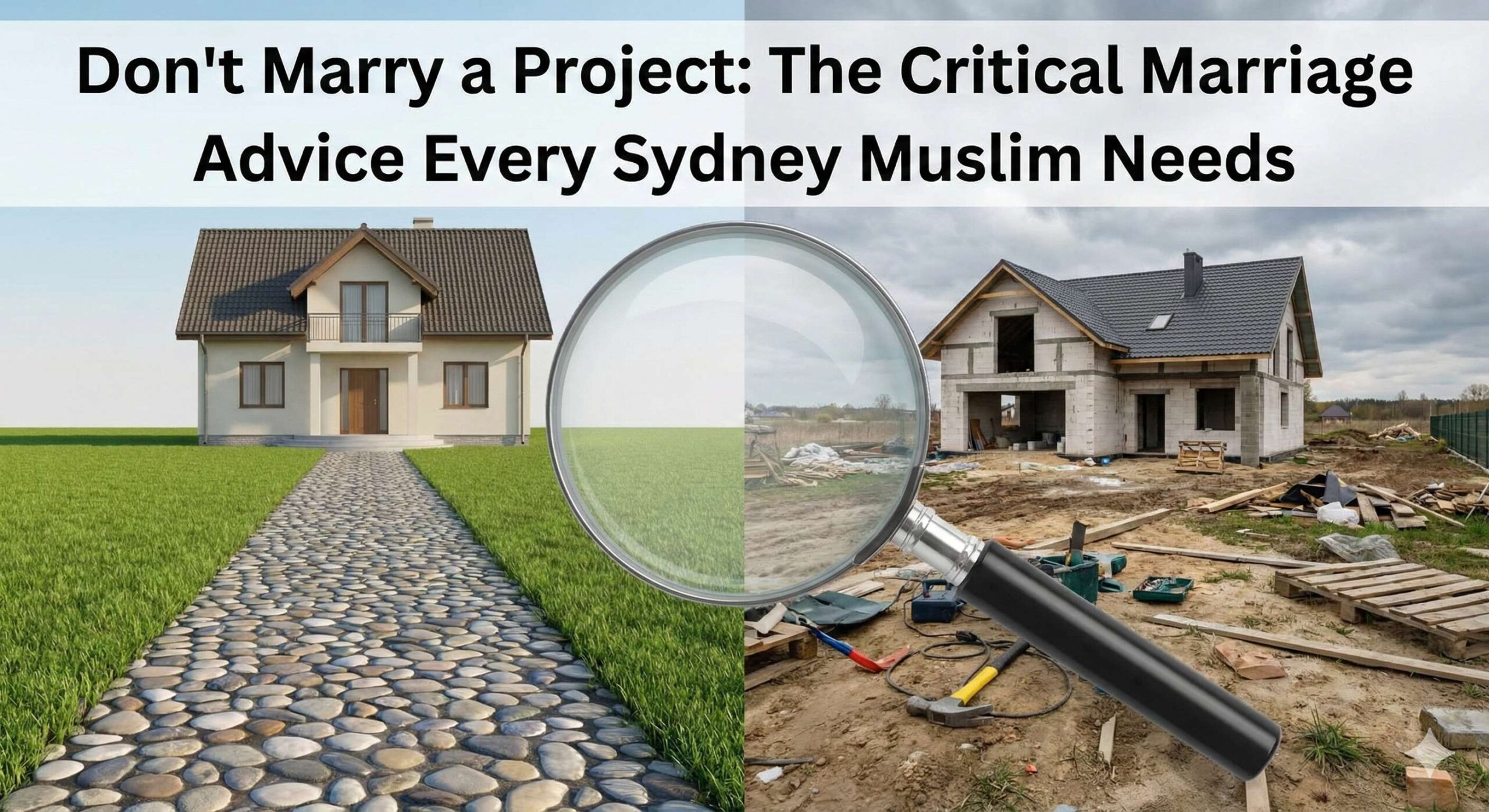
Are You About to Make the Biggest Mistake of Your Life?
Who you marry is going to impact your offspring. When you choose a spouse, you’re not just choosing a companion for yourself. You’re choosing a parent for your future children. That character is going to transfer. The trauma is going to transfer. The values are going to be inherited.
As Bilal Dannoun, a Sydney-based Muslim marriage celebrant specializing in Sharia-compliant nikah ceremonies and Islamic counselling, I’ve counseled thousands of couples across Sydney, from Bankstown to Parramatta, from Liverpool to Lakemba. I’ve seen the same mistake repeated again and again, destroying marriages before they even truly begin.
Today, I want to share critical advice that could save your marriage before you even say “I do.” You don’t just marry a person. You marry a package. And one of the biggest problems we have when it comes to marriage is that many people, especially the brothers, they marry potential, or they marry a project.
Let me be very clear: Two words to remember. Don’t marry a project. Don’t marry potential.
What Does “Marrying a Project” Mean?
The Common Scenario
They find someone. “Oh, mashallah, she’s a revert and I want to be the one that gets her to Jannah. I’m going to be the one who helps her.” Yes, mashallah, that’s a noble intention. But have you looked at whether this woman is going to be fit for you in terms of her character? Does she have trauma? Does she have any issues?
We can’t just be wishfully thinking. That’s called marrying a project. Marrying someone that you want to fix. Marrying someone who’s traumatized. “She’s been traumatized. She’s been through so much. I want to make it up for her. I want to be the one who saves her. I want to be her everything just to really help her for the sake of Allah.”
What he doesn’t understand is it’s probably more complicated than he thinks.
The Reality Check
You can’t change people. It’s not that easy. Change must be something from within the person themselves. They need to want that change. They need to be prepared to do the work to change.
Sometimes, you know what the problem is? People think that you only need to do this much, a little bit of effort, to get this result over here. But the reality is you have to do this much to get to that result. There’s no shortcuts here. You have to do the work.
When Women Try to Change Men
If you are a woman and you try to change a man, guess what? Guess how he’s going to look at it?
If you marry him because you want to help him, eventually what happens when you enter the marriage is that he will feel like you’re controlling him. Why? Because Allah created the man to be the leader. He is the leader. He’s not a dictator. And then you will come across as being a mother to him. That’s what happens in reality.
Quote from Bilal Dannoun: “The biggest problem in many marriages across Sydney is that people marry potential instead of reality. They marry a project instead of a partner. This is a recipe for disaster, whether you’re in Lakemba, Bankstown, or anywhere else.”
The Harvard Interview Approach: How to Choose Wisely
One of the things that I would love for our brothers and our sisters to do when they come to get married is to interview their potential spouse the way Harvard would interview their students.
How Harvard Does It
To get into Harvard or to get into elite universities, you have to go through some rigorous questioning and assessments. You can’t just get in. It’s Harvard, for God’s sake.
But once you are in, what happens? They treat you with excellence.
Apply This to Marriage
In the beginning, don’t go emotionally connecting and investing your heart before you’ve done all the work. Once you’re emotionally invested and your heart’s there, it’s a lot more difficult to get out.
I want you to be like Harvard:
- Do all the questioning
- Ask the hard questions
- Complete all assessments
- Then, once you enter the marriage, be a person of ihsan (excellence) toward that person
This is the proper sequence. Too many people in Parramatta, Auburn, and across Greater Sydney get this backwards. They fall in love first, then try to ask questions later when their judgment is already clouded.
What to Look for: Shared Vision and Compatibility
From amongst the things that I want you to consider, and I’m keeping time in mind, is to ensure that you also have:
The Essential Elements
- Shared vision with your spouse
- Being on the same page
- Shared lifestyle
- Emotional maturity
- Similar goals
Chemistry vs. Compatibility
Yes, the chemistry can excite you, but I’ll tell you what: it never sustains the marriage. Chemistry never sustains the marriage. Don’t be deceived.
You know what sustains a marriage?
- Religiosity
- Your deen
- Your compatibility
- Being on the same page
- Working together as a team
The Garment Analogy
Just as Allah says, you are each other’s garments. She is your garment. You are her garment.
If you think about your garments, they are the closest thing to your body. The relationship between a husband and wife is always intimate and close.
If you think about your garments, they give you:
- Confidence
- Warmth
- Security
That’s how the relationship should be.
Quote from Bilal Dannoun: “Chemistry excites you in the beginning, but religiosity and compatibility sustain you for a lifetime. This is true whether you’re in Liverpool, Campbelltown, or anywhere across Sydney.”
Understanding Tolerance in Marriage
When you enter a relationship, you need to know your tolerance level. How much can you tolerate?
Everyone Has Different Tolerance Levels
You need to understand that some people can tolerate certain behaviors; other people can’t. I have people in front of me during counseling and I think, “Subhan Allah, how is this person able to tolerate this? I couldn’t tolerate this, but they can.” Conversely, I can tolerate things they can’t tolerate.
Everyone has different tolerance, and that’s a very important word to add to your marriage vocabulary. What are you prepared to tolerate when it comes to marriage?
The Critical Statement About Tolerance
One thing after marriage when it comes to the word tolerance that I want to share with you:
When it comes to bad behavior, when it comes to bad treatment, remember this statement: The more you tolerate, the more you teach them how to treat you.
The more you tolerate bad behavior, the more you teach them how to treat you.
Think About It Like Teaching
Think about it as a teacher. Think about it as a student. As a teacher, the more you tolerate your students’ bad behavior, what are you teaching your children? That they can:
- Get away with it
- Run the show
- Run amok
- Walk all over you
But when you have standards, when you have values, when you have boundaries, this is where it changes.
This applies whether you’re newly married in Greenacre, struggling in your marriage in Auburn, or counseling couples in Bankstown.
Quote from Bilal Dannoun: “I tell couples across Sydney all the time: the more you tolerate bad behavior, the more you teach your spouse how to treat you. Standards, values, and boundaries are not optional in a healthy marriage.”
The In-Law Challenge
One thing that I also want to say when it comes to relationships that’s very important is in-laws.
The Cultural Problem
When it comes to in-laws, this is very problematic in many cultures. Very problematic. Why? Because now they want to bring the culture into the marriage.
There are some cultures that I’ve come across where, when you get married, you must live with your in-laws. This means the woman living with her husband’s parents. And then there are problems. How do you get out of that?
The Solution: Healthy Boundaries
It’s important to have healthy boundaries when it comes to in-laws. There’s lots of content and lots of work that’s been written about this that I would love for you to learn about, especially if you plan on living with your in-laws, so that you know how to navigate the situation.
Best Practice
It is best practice not to live with your in-laws. From the knowledge and from the experience, it is best practice not to live with your in-laws.
But there are some circumstances where you need to live with your in-laws for whatever those circumstances are. If that is the case, make sure you have very healthy boundaries with them.
This is true whether you’re dealing with in-laws in Lakemba, Liverpool, or any other Sydney suburb. The principles remain the same.
The Key to a Happy Marriage: Taqwa and Salah
Good marriage is going to keep you happier and healthier. Remember some of the key words today, and they are taqwa.
The Connection to Divorce
If you want to have a healthy marriage, you must have taqwa. In Surah At-Talaq, which is a chapter about divorce, Allah mentions taqwa at least four times. He says that Allah is reminding us that one of the best ways to avoid divorce is to have taqwa.
The Prayer Connection
When Allah is speaking about the rules and regulations regarding divorce, somewhere there in this context, in this passage, Allah says: “Maintain and protect your prayers, and in particular the middle prayer.”
The commentators of the Quran started discussing this and they said, “Why is this here?” And so they said: maybe Allah is hinting that when you spoil your relationship with Allah by not praying to Him five times a day, He may spoil your relationship in your marriage.
This is profound. The connection between your salah and the health of your marriage is not coincidental. It’s divinely ordained.
The Pillars to Remember
Remember:
- Mawadda (affection)
- Rahmah (mercy)
- Tolerance
- All of these words
So that you have a marriage that is built upon the proper foundation, whether you’re in Parramatta, Bankstown, or anywhere across Greater Sydney.
Quote from Bilal Dannoun: “I’ve counseled thousands of couples, and I can tell you with certainty: those who maintain their five daily prayers have stronger marriages. When you spoil your relationship with Allah, don’t be surprised when your marriage suffers.”
Don’t Marry a Project: The Summary
Let me summarize the critical lessons from today:
What NOT to Do
- Don’t marry potential: Don’t marry someone hoping they’ll change
- Don’t marry a project: Don’t marry someone you want to fix
- Don’t ignore trauma: Unresolved trauma will show up in your marriage
- Don’t skip due diligence: Don’t emotionally invest before doing the hard work
- Don’t ignore red flags: They’re there for a reason
What TO Do
- Interview like Harvard: Ask the hard questions first, then commit
- Look for shared vision: Make sure you’re on the same page
- Prioritize deen and character: Chemistry fades, but these sustain
- Understand tolerance levels: Know what you can and cannot tolerate
- Set clear boundaries: Especially with in-laws
- Maintain your salah: Your relationship with Allah affects your marriage
- Remember: You marry a package, not just a person
The Two P Words to Avoid
Remember these two words:
- Project: Don’t marry someone you want to fix
- Potential: Don’t marry someone hoping they’ll change
Change must come from within the person themselves. They need to want that change. They need to be prepared to do the work.
For Those Not Yet Married: A Special Dua
For those of you who are not married, may Allah bless you to become the best version of yourself before marriage. May Allah then bless you with the best person who will bless you with the best children. May you all be traveling together toward Jannah, and may you be a family in Jannah.
This is the dua I make for all the singles I meet across Sydney, from the matrimony events in Bankstown to the counseling sessions in Lakemba, from the young men in Liverpool to the sisters in Parramatta.
Quote from Bilal Dannoun: “Work on yourself first. Become the person worthy of the spouse you’re asking Allah to send you. Don’t expect to marry someone amazing when you haven’t done the work to become amazing yourself.”
Common Questions About Marrying Wisely
Q: How do I know if I’m marrying potential instead of reality?
Ask yourself: “Would I be happy marrying this person exactly as they are today, with no changes whatsoever?” If your answer is “no” or “only if they change this or that,” you’re marrying potential. Don’t do it.
Q: What if I genuinely want to help someone who’s struggling?
Helping someone is noble. Marrying them to help them is dangerous. Help them as a friend, as a community member, as a brother or sister in Islam. But don’t make them your life partner hoping to fix them. Marriage is hard enough without adding that burden.
Q: Isn’t it harsh to reject someone because they have trauma?
It’s not about rejection. It’s about timing and readiness. If someone has unresolved trauma, they need to work on that with professional help before marriage. You can’t be their therapist and their spouse. That’s not fair to either of you.
Q: How rigorous should my “interview” process be?
Very rigorous. You’re choosing a life partner and a parent for your children. Ask about:
- Their relationship with Allah (salah, fasting, Quran)
- Their relationship with their family
- Their financial habits and expectations
- Their views on parenting
- Their past (trauma, addictions, major issues)
- Their goals and vision for life
- How they handle anger and conflict
Q: What if everyone I meet has some issues?
Everyone has issues. The question is: are those issues deal-breakers? Are they unresolved and destructive, or are they manageable challenges that the person is actively working on? There’s a difference between marrying someone who’s aware of their issues and working on them versus marrying a project.
Q: How do I set boundaries with in-laws before marriage?
Discuss this with your potential spouse before marriage. Be clear about expectations:
- Will you live separately or with in-laws?
- What role will in-laws play in decision-making?
- How will you handle disagreements involving in-laws?
- What are the visiting expectations?
Get on the same page before the nikah, not after.
Take Action Today with Bilal Dannoun
As a Sydney-based Muslim marriage celebrant who has seen both the best and worst of marriages across all Sydney suburbs, I’m committed to helping you make the right choice from the beginning.
My Services Include:
- Pre-marriage counseling: Where we thoroughly assess compatibility and readiness, ensuring you’re not marrying a project
- Sharia-compliant nikah ceremonies (online and in-person) across all Sydney suburbs
- Marriage counseling for couples at any stage who need guidance
- Islamic divorce services handled with compassion when necessary
- Notice of Intended Marriage (NOIM) assistance ensuring legal and Islamic compliance
- Flexible ceremony locations: Your mosque, home, chosen venue, or my dedicated marriage reception lounge
- Online marriage course with 117 videos covering everything from choosing a spouse to maintaining a healthy marriage
For Singles: Before you say “I do,” let me help you do your due diligence. Don’t marry a project. Don’t marry potential. Let’s make sure you’re choosing wisely, whether you’re in Bankstown, Liverpool, Lakemba, Parramatta, Auburn, or anywhere across Greater Sydney.
For Parents: If your son or daughter is considering marriage, gift them a pre-marriage counseling session. It could save them from years of heartache.
For Married Couples: If you’re struggling because you did marry a project or potential, it’s not too late. Let’s work on setting proper boundaries, managing expectations, and building the marriage you deserve.
Remember: You don’t just marry a person. You marry a package. Make sure it’s a package you can live with for the rest of your life.
May Allah bless all marriages with sakina (tranquility), mawadda (affection), and rahmah (mercy). May He guide us to choose wisely and marry for the right reasons. May He protect us from marrying projects and help us become the best versions of ourselves before we seek a spouse.
Contact me today to discuss how I can help you navigate the marriage process with wisdom, whether you’re preparing for marriage, currently engaged, or working through challenges in your current marriage.
From Bankstown to Parramatta, from Liverpool to Lakemba, I’m here to ensure you build a marriage on the solid foundation of reality, not the shaky ground of potential and wishful thinking.
Don’t marry a project. Marry a partner. Let me help you know the difference.