
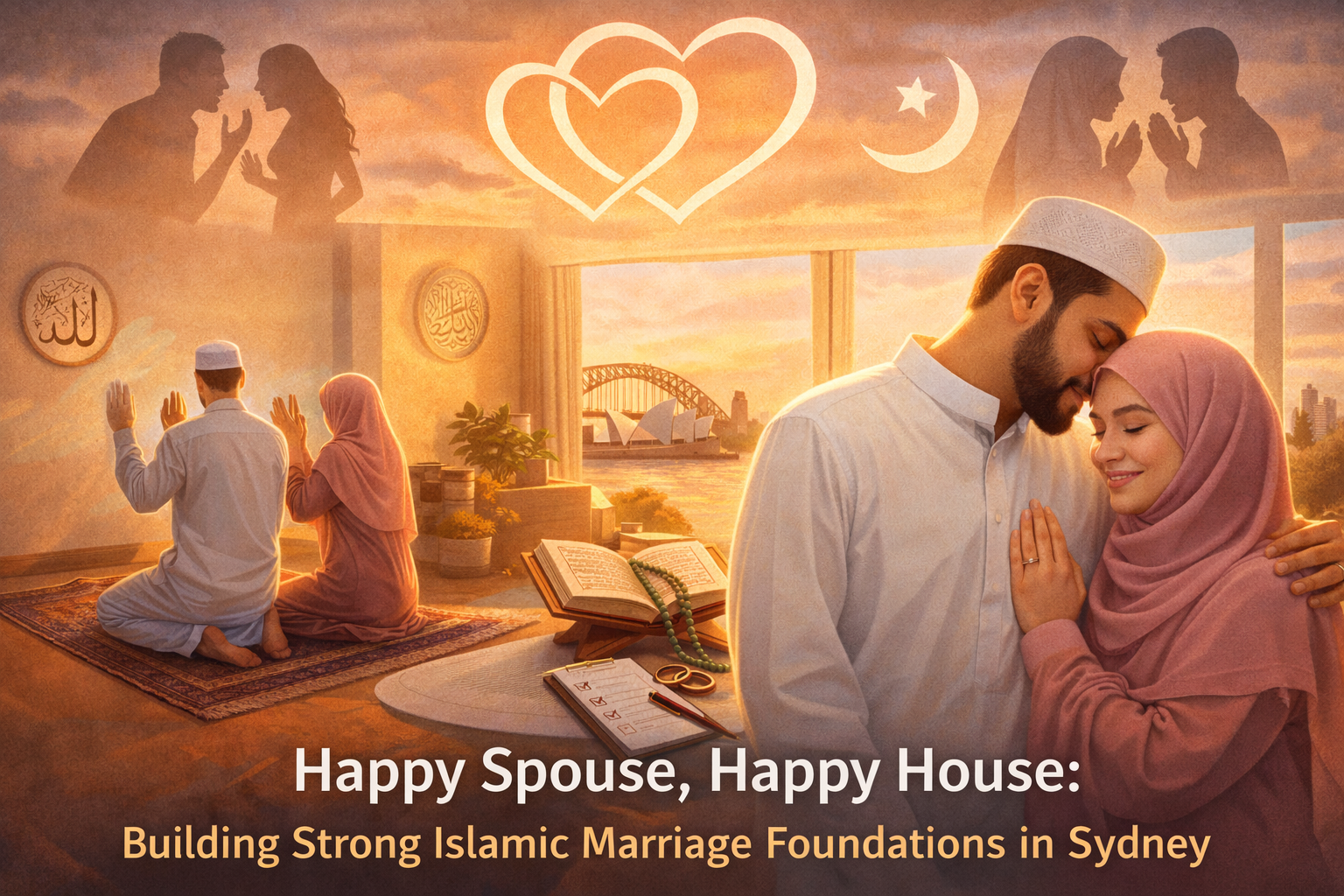
What’s the Secret to a Thriving Marriage That Actually Lasts?
After counseling thousands of couples across Sydney, from Bankstown to Parramatta, from Liverpool to Lakemba, I’ve discovered a fundamental truth: the happier you are as a spouse, the happier you’ll be in every aspect of your life. Your marriage isn’t just about domestic bliss; it affects your productivity at work, your focus throughout the day, your income potential, and yes, even the taste of your spouse’s cooking!
As Bilal Dannoun, a Sydney-based Muslim marriage celebrant specializing in Sharia-compliant nikah ceremonies and Islamic counselling, I’ve noticed something remarkable: I often feel like a “broken record” in my counseling sessions because couples across all cultures, whether Desi, Arab, or Southeast Asian, face remarkably similar challenges. We’re all human beings who “bleed the same color” and share the same fundamental struggles.
The Quran beautifully describes the purpose of our homes: Allah has made our homes a place of sakina (tranquility). In Surah Ar-Rum (30:21), Allah says He created for us mates “so that you may find tranquility (sakina) in them.” This concept of sakina is so central to Islamic marriage that we place this verse on our wedding invitations. When you’re in a tranquil state, you become the best version of yourself.
Let me share the essential tools, rules, and real-world insights from my daily interactions with couples that will help you establish that sakina in your marriage.
The Foundation: Knowledge Before Marriage
The Problem: The number one contributor to marriage success, and the most commonly missing element, is pre-marriage knowledge. Too many couples enter marriage without understanding their duties, roles, boundaries, standards, expectations, or even basic Islamic marriage principles.
Many of us don’t come from healthy marriages ourselves. Perhaps our parents got it wrong, we come from divorced families, or we never witnessed genuine affection between spouses. How can we model what we’ve never seen?
The Solution:
- Invest in pre-marriage education: In Malaysia, couples cannot marry without completing pre-marriage counseling and obtaining a certificate. Studies show that couples who undergo pre-marriage counseling have an 85% better chance of maintaining their marriage compared to those who don’t.
- Learn the fundamentals: Understand the rights and duties of husbands and wives in Islam. For example:
- The husband’s primary responsibility is providing financially for his wife: food, drink, clothing, and shelter according to community norms and customs
- The Prophet (peace be upon him) taught: “The best of you are those who are best to their families, and I am the best to my family”
- For wives: When a woman prays her five prayers, fasts Ramadan, maintains her chastity, and is obedient to her husband, she can enter Paradise through whichever gate she wishes
- Understand what truly matters: A Harvard study tracking 730 men over 75+ years found that the common denominator among successful, respected, happy individuals was healthy relationships. The study concluded: “Good relationships keep you happier and healthier.”
Quote from Bilal Dannoun: “Knowledge is the first and most important contributor to a thriving marriage. When you don’t know what’s expected, you’re going to get into trouble. This is the fundamental problem we face.”
Priority #1: Your Connection with Allah
After knowledge, the second most crucial contributor to marriage success is your relationship with Allah.
The Reality Check:
- Who controls your spouse’s heart? Allah
- Who can turn hearts toward you or against you? Allah
- Who blesses your marriage? Allah
The Quran states: “Those who believe and do righteous deeds, the Most Merciful will instill affection (wudd) for them in the hearts [of others]” (Surah Maryam, 19:96). When Allah loves you, Jibril loves you, the angels love you, and people on Earth will love you.
The Pious People’s Wisdom: Our righteous predecessors used to say, “Repair your relationship with the Creator, and He will repair your relationship with the creation.”
Real-Life Example: I recall a sheikh who came to mediate between a husband and wife. When he entered their beautiful, newly-built home, his first question was: “How did you purchase this house? Through riba (interest)?” When they confirmed it was financed through a bank loan, he stood up and said, “Assalamu alaikum. That’s your problem right there. You went to war with Allah by dealing with interest. How do you expect me to save the day?”
The Quran warns us: “Whatever misfortune befalls you is due to what your own hands have earned, and He pardons much” (Surah Ash-Shura, 42:30).
Action Steps for Allah-Centric Living:
- Prioritize Salah: My first question to every couple is, “Tell me about your Salah.” This immediately reveals an action item for improvement. Salah is your silah (connection) with Allah. Without it, how can you maintain connection with human beings?
- Understand the heart’s hierarchy: Your heart is the storehouse of everything you love: Allah, people, money, work. But the core of your heart must belong to Allah alone. If you place anything else in that core position, three things can happen:
- Allah may corrupt your heart
- That thing becomes your greatest source of pain
- It negatively impacts every other layer of love in your heart, including your spouse and children
- Practice morning and evening supplications: These protections (adhkar) take only 10 to 15 minutes and include a powerful dua for your family: “O Allah, protect me and my family members.” Recite after Fajr and Asr to shield your marriage from harm.
Playing Your Role: Masculinity and Femininity in Islam
The Modern Confusion: One significant problem in contemporary marriages is the lack of clear masculinity and femininity. Men aren’t being men, women aren’t being women, and role confusion creates imbalance.
Understanding Gender Roles Islamically:
For Husbands:
- Be attractive through responsibility and maturity
- Fear Allah and demonstrate good manners
- Show courage and leadership
- Be the imam of your household. Just as the masjid has an imam, you lead your family
- Provide financially as the hunter-gatherer
- Remember: even if a sheikh visits your home, you lead the prayer because you are the man of the house
For Wives:
- Embrace femininity as Allah created you
- Maintain yourself in ways that make you attractive to your husband
- Recognize your naturally agreeable nature (though this doesn’t mean being a doormat)
- Understand your role: “The best place for a woman is her home”
- Be present for your children and husband. When you’re absent, something suffers: parenting, housework, health, or your marriage
Important Reminder: The Prophet (peace be upon him) said, “Go easy on the fragile vessels.” Husbands must work with their wives’ naturally more fragile nature, showing gentleness and understanding.
Quote from Bilal Dannoun: “Allah created you in a certain way that makes you attractive to your spouse. We need to understand what it looks like to be a man and a woman in Islam, and then own that role.”
The Power of Effective Communication
The Root of Most Problems: If I had to create one heading for the top 20 reasons couples divorce, it would be failed expectations. Every issue (abuse, lack of commitment, financial problems, in-law interference, infidelity) stems from unmet expectations.
Failed expectations sound like:
- “I didn’t think you’d cheat on me”
- “I didn’t expect you to be so stingy”
- “I didn’t think you’d refuse to spend time with me”
- “I didn’t expect such disrespect”
The Solution: Communicate Everything from the Start
From day one, communicate:
- Your expectations
- Your standards
- Your boundaries
- Your values
- Your needs
- Your love language
- Your insecurities
No guesswork. Tell each other what you want, own it, and show up consistently.
The Mirror Analogy: Imagine a clear glass panel between you and your spouse. Initially, you see each other perfectly. But over time, hurts accumulate: felt expectations here, disrespect there, no quality time, lack of consideration. Each hurt creates a stain on the glass until you can barely see each other. This represents emotional disconnection, which leads to physical disconnection.
The NOS Strategy: I teach couples about “NOS” (No Offense Sessions), regular, scheduled times to discuss problems without letting them fester. A study of 700 couples married over 30 years (all over 65 years old) found the common denominator: they could sit down and have uncomfortable conversations about difficult situations without escalation.
This requires:
- Wisdom (hikmah)
- Mercy (rahma)
- Patience (sabr)
Quote from Bilal Dannoun: “Life is too short to have constant skirmishes in your relationship. Remember the Quranic advice: ‘Do not forget the good between you both.’ What you focus on grows. Focus on small negative moments and they become magnified.”
Conflict Resolution: Fighting Without Fighting
The Reality: Many couples don’t know how to disagree with respect and dignity. They lack emotional intelligence and healthy conflict resolution strategies.
Understanding Your Brain During Conflict: When you become emotionally charged and angry, your emotional brain takes over. Adrenaline floods your system, cortisol pumps through your body, and you’re operating from the emotional side of your brain rather than the rational side.
It takes 90 seconds for your brain to switch from the emotional side to the rational side. This is why counting to 100 works: you’re giving your rational brain time to engage.
The Prophet’s Advice: When a companion repeatedly asked for advice, the Prophet (peace be upon him) said three times: “Do not get angry.” The scholars understood this to mean that anger is the root of all evil.
Islamic scholars also teach: Divorces pronounced in a state of rage and high-level anger are not binding because “you’re not in your right mind.” You’re operating from the emotional brain, not the rational one.
Practical Conflict Resolution Strategies:
- Get curious before furious: This should be your new approach. Before reacting, ask questions and seek to understand.
- Implement the Timeout (TO) Card:
- Agree beforehand that either spouse can call a timeout when emotionally flooded
- The person calling timeout says: “I’m too angry right now and might say something hurtful. I don’t want to hurt you. Can you please give me time out?”
- Minimum timeout: 20 minutes (per research)
- Maximum timeout: 24 hours (after this, Shaytan starts making things worse)
- The person who called timeout returns when ready and says: “When you’re ready, I’m ready to discuss the problem”
- Remember: The problem is the problem. Your spouse is not the problem. If they were the problem, you wouldn’t have married them.
- Avoid the Three Rs:
- Resistance (refusing to talk about problems) leads to…
- Resentment (built-up bitterness) which leads to…
- Rejection (“Don’t touch me, don’t come near me”)
The Story of Ali and Fatimah: When the Prophet (peace be upon him) visited and found they had argued, he didn’t ask what happened or take sides. He went looking for Ali and found him sleeping in the masjid with dust on his clothes. The Prophet gently woke him saying, “Get up, O Father of Dust.”
Lessons from this story:
- Ali’s exit strategy: Instead of escalating, he went to the masjid
- The Prophet didn’t interrogate or blame
- The best emotional home when distressed is Allah’s house
- Allah sent the Prophet as a gift to Ali when he turned to Him
- This teaches parents not to immediately interfere in their children’s marital disputes
Quote from Bilal Dannoun: “Many of us go to harmful emotional homes when stressed: drugs, gambling, inappropriate content, or conversations with the opposite gender. Ali went to the masjid, teaching us that the best place to find solutions is in turning to Allah.”
The In-Law Challenge: Family Interference
The Reality: Family interference ranks in the top three causes of divorce across Sydney’s Muslim community.
Common Problems:
- Parents who don’t respect boundaries
- Emotional blackmail from family members
- Taking control of marital disputes
- Living arrangements that lack privacy
The Solutions:
- Establish separate living: Even granny flats or upstairs/downstairs arrangements often don’t provide sufficient boundaries. I’ve seen complaints like “Why didn’t you come downstairs to greet me?” cause serious friction.
- Seek third-party help first: Before involving parents, consult an Islamic counselor, psychologist, or knowledgeable sheikh who understands relationships. Parents, though well-meaning, may escalate situations through emotional involvement.
- Practice justice (adl): The Quran commands, “Be just, even if it concerns yourselves or your parents” (Surah An-Nisa, 4:135). Your parents being your parents doesn’t mean they’re always right. They’re human and fallible.
- Set and maintain boundaries: Communicate respectfully but firmly about privacy and decision-making autonomy in your marriage.
Real-Life Example: A sister consulted me about her husband, describing his irresponsibility and immaturity. Later, she revealed she didn’t grow up seeing men behave this way. Often, our expectations are shaped by our own family experiences, which may not match our spouse’s upbringing.
Quote from Bilal Dannoun: “Less is more with parents. Taking matters to them often leads to taking control, emotional blackmail, and taking sides. It’s better to seek impartial, professional help.”
The Three Essential Safeties
Your spouse needs to feel three types of safety:
1. Physical Safety
- No domestic violence
- No abuse of any kind
- Emotional intelligence to de-escalate situations
- Clear rules about never resorting to physical aggression
2. Emotional Safety
- Trust that your partner won’t cheat
- Boundaries with the opposite gender
- Transparency in communications and social media
- No inappropriate relationships at work or elsewhere
3. Mental Safety
- Respect during disagreements
- No verbal abuse, swearing, or put-downs
- Maintaining dignity even during conflicts
- Emotional intelligence in all interactions
When these three safeties exist, the emotional connection remains strong, which naturally leads to a healthy physical connection.
Quote from Bilal Dannoun: “As long as you’re providing safety and certainty, the relationship should be very well. But when one person is doing well and the other isn’t, the relationship won’t do well. It’s basic science, like a symbiotic relationship in biology.”
Certainty vs. Uncertainty
Certainty creates contentment, happiness, and safety.
Uncertainty creates anxiety, stress, and disconnection.
When Uncertainty Enters:
- Secrecy (“What’s he doing? Why is she being secretive?”)
- Unexplained behaviors
- Inconsistent actions
- Broken trust
Building Certainty:
- Transparency in your actions and whereabouts
- Consistent behavior that matches your words
- Openness in communication
- Addressing your spouse’s concerns without defensiveness
Special Case: Trauma-Induced Insecurity: Sometimes a spouse brings insecurity from past trauma (parental abandonment, previous betrayal). If you created this insecurity through past mistakes (like infidelity), you must:
- Take responsibility for creating that uncertainty
- Work patiently with their insecurity without taking it personally
- Rebuild trust through consistent, transparent behavior
- Understand this is the price of rebuilding what you broke
The Power of Morning and Evening Adhkar: These supplications protect your marriage from waswas (whispers of Shaytan that create doubt and anxiety). Use the Fortress of the Muslim app and complete the full package after Fajr and Asr. They turn down the volume of harmful thoughts.
Quote from Bilal Dannoun: “When someone has genuine waswas about something, they overthink and need certainty. The other partner should never challenge that. They should provide that certainty because maintaining certainty is maintaining connection.”
Quality Time: The We-Time and Me-Time Balance
The Problem: Quality time together is one of the five love languages and a major complaint in marriages, especially after children arrive.
Research Finding: Studies show that after having a child, marriage satisfaction can decrease by up to 45% if couples don’t maintain good disciplines and planning. The relationship goes from being a dyad (two people) to a triad (two adults and a child), and suddenly “baby number one” (the husband) becomes “baby number two.”
The Solution: Balance We-Time and Me-Time
We-Time Moments:
- Schedule dedicated couple time weekly (date nights)
- Dress up like you did during your honeymoon phase
- Have walks, coffee dates, dinners together without phones
- Create opportunities for emotional connection
Me-Time Moments:
- Recognize each person needs individual space
- Respect work time, personal hobbies, and individual responsibilities
- Balance household duties, parenting, and personal needs
Important Reminder: The Prophet (peace be upon him) endorsed Salman’s advice: “Your Lord has a right over you, your body has a right over you, and your family has a right over you, so give each one their due right.”
For Mothers at Home: If your wife is home all day managing children and housework, she needs adult conversation and a break. She didn’t marry just to manage domestic duties; she wants meaningful time with you.
Quote from Bilal Dannoun: “I can taste the vitamin L (vitamin Love) in my wife’s cooking when she’s happy with me. When she’s not, it doesn’t taste the same. Quality time creates that emotional connection that makes everything else flow naturally.”
Addressing Trauma and Healing
The Powerful Truth: “If you don’t heal what hurts you, you will bleed all over those who never cut you.”
Where Trauma Shows Up: The remnants of trauma and unhealed wounds show up most prominently in marriage. When I ask questions and dig deeper, I often discover that problematic behaviors stem from:
- Abusive parents
- Neglectful parents
- Witnessing unhealthy parental relationships
- Childhood abandonment or betrayal
Real-Life Example: A brother whose wife complained he “lies about everything” revealed that his father repeatedly betrayed his trust by sharing his private matters with everyone, embarrassing him. This unhealed trauma manifested as an inability to trust his own wife.
Another Example: A sister whose father abandoned the family experiences separation anxiety whenever her husband travels for work, constantly calling and texting because she fears abandonment, even though her husband is simply working.
The Solution:
- Recognize the pattern: Understand how your past wounds affect your present behavior
- Obsess over healing: Just as you research extensively before buying a car or phone, invest that same energy into addressing your trauma and weaknesses
- Seek professional help: Work with Islamic counselors or Muslim psychologists who understand both Islamic principles and human psychology
- Break generational trauma: Do the work now so your children don’t inherit these patterns. Without healing, trauma gets passed from generation to generation
- Trust in Allah: For issues beyond your control (like estranged family members), make dua and leave the outcome to Allah
Quote from Bilal Dannoun: “Most people are traumatized in one way or another: narcissistic parents, abusive situations, various hardships. Islam has the solution, but you must do the work to become a better version of yourself as a Muslim, worshiper, spouse, parent, and family member.”
Practical Guidelines for Singles Seeking Marriage
For our brothers and sisters across Sydney seeking marriage:
What to Look For (Based on the Prophet’s Teaching):
The Prophet (peace be upon him) taught that people marry for four reasons: beauty, wealth, lineage, and deen (religion). He advised prioritizing deen.
However, attraction matters too. I’ve seen marriages fail when brothers married solely for deen without genuine attraction. The proper order:
- Attraction and chemistry: Can you see yourself being intimate with this person? Is there genuine attraction?
- Strong deen: Do they prioritize Allah and practice Islam sincerely?
- Good character: Observe how they treat their family. This indicates how they’ll treat you
- Compatible life goals: Ask questions about values, expectations, family planning, work, etc.
Essential Pre-Marriage Questions to Discuss:
- Views on gender roles and feminism
- Expectations about working (for women)
- Children and parenting approaches
- Financial management and expectations
- Living arrangements (with or separate from in-laws)
- Religious practice and priorities
Where to Find a Spouse in Sydney:
- Network through mosques and Islamic centers from Parramatta to Liverpool
- Volunteer in community organizations
- Consult family connections
- Consider reputable matchmakers
- Use matrimonial websites cautiously: quality varies greatly; some contain more harm than good
About Matrimonial Websites: Research thoroughly, involve family members, and exercise extreme caution. Many have questionable people with dubious intentions. Traditional community-based methods often yield better results.
About Marrying Reverts: If someone wants to embrace Islam to marry you, ensure they’re doing it for Allah, not just for the marriage. Suggest they:
- Complete several months of Islamic education
- Learn the foundations and pillars of Islam
- Demonstrate genuine commitment before marriage
- Understand this isn’t just a formality but a complete way of life
Quote from Bilal Dannoun: “I’ve seen happy endings and very sad endings with revert marriages. It’s a mixed bag. That’s why due diligence, taking your time, and ensuring genuine commitment to Islam is crucial. It’s easier when you marry someone who’s genuinely Muslim and shares your vision.”
The Importance of Intentions
A crucial principle from Islamic scholars: “Actions are judged by their underlying motives, and every person will be rewarded according to what they intended.”
For Marriage Success:
- Are you marrying to please Allah or to please people?
- Are you addressing problems with sincere intentions to improve?
- Are you performing your role as spouse seeking Allah’s pleasure?
- Are you treating your spouse the way Islam teaches or following cultural norms?
The More Purified Your Heart: The more purified your heart and sincere your intentions, the more you’ll receive from Allah.
Sources of Barakah (Blessing) in Marriage:
- Sincerity (Ikhlas): Placing Allah first in your marriage
- Good deeds and avoiding sins: Fulfilling obligatory acts and staying away from prohibitions
- Morning and evening supplications: Consistent protection through adhkar
- Sadaqah (charity): Encourage your spouse to give regularly. This adds barakah to the relationship
- Dua: Making specific, consistent dua for your marriage
Quote from Bilal Dannoun: “If you have the right intention to make the marriage work, if you have the right intention to please Allah in treating your spouse as Allah wants, Allah will bless your marriage. But if you’re doing it for any other reason, you’ll never find barakah even if you follow all the recommended steps.”
Critical Reminders About Seeking Help
When to Escalate Problems:
- First: Make dua. Ask Allah to help your spouse cooperate and become better
- Second: Speak to a non-family member whom your spouse respects (a sheikh, counselor, or trusted community member)
- Third: If needed, seek professional mediation through Islamic organizations
About Going to Civil Courts: The Islamic position is clear. We should use Islamic intervention, arbitrators, mediators, and scholars first. Civil courts may apply laws contrary to Sharia regarding rights and responsibilities. Australia’s Muslim community has:
- Islamic mediators
- Arbitrators
- Qualified scholars
- Intervention services
Use these resources first. Yes, the system is slower and we’re in teething stages, but don’t rush to civil courts where Islamic principles may be compromised.
Important Message for Those Struggling:
Don’t wait until problems become unbearable. Raise your hand early and seek help. There’s no shame in saying, “I’ve got an issue in my marriage and need help.”
For Sisters Especially: You have a beautiful Muslim community here that will always support you. If you have no family in Australia, don’t think you’re alone. You have brothers and sisters, community support, and resources available. Reach out; we’re here for you.
Quote from Bilal Dannoun: “Be patient with the mashayikh (scholars). We receive countless messages daily while conducting counseling sessions, performing nikahs, giving lectures, and caring for our own families. Message us, clearly state you need help, and be patient. We’re doing our absolute best to serve the community.”
Common Questions Answered
Q: Can a marriage that started from a haram relationship succeed?
If both partners have sincerely repented to Allah and turned back to Him, there is hope and optimism for success. However, you’re taking a gamble starting on weak foundations. The key is:
- Genuine repentance (tawbah) to Allah
- Right intentions going forward: are you marrying to cover up the haram or to establish a healthy Islamic marriage for Allah’s sake?
- Starting fresh with proper foundations: halal wedding, avoiding riba for housing, keeping everything pleasing to Allah
Q: Should I compromise in marriage, and how far?
Compromise on day-to-day issues (where to place kitchen appliances, when to go out, furniture arrangement), but never compromise on Islamic values and principles. Allah’s commands are about submission and surrender. Following them brings peace.
For day-to-day matters: communicate, keep the peace, empathize, and show flexibility.
Q: Is it better to marry someone from a similar family background or with a similar vision?
Similar vision is more important. You could come from very different backgrounds but share the same values, goals, and Islamic priorities. A revert, for example, may not share your family background but could perfectly share your vision for an Islamic life.
Discuss thoroughly:
- Life goals and expectations
- Parenting approaches
- Financial management
- Religious practice
- Work and home balance
Q: Can a woman work or pursue education?
In Islam, knowledge that brings you closer to Allah is beneficial. Some knowledge is fard kifayah (communal obligation). The Muslim community needs female doctors, midwives, and teachers. This knowledge is permissible and necessary.
However, priorities matter:
- The home is the wife’s primary domain
- Work should not negatively impact home, children, or the marital relationship
- The husband is the primary breadwinner
- If a wife works, it should be balanced with her home responsibilities
- Communication about expectations is essential
The husband can request his wife not work; he’s the leader (not dictator). If work was agreed upon before marriage, that agreement should be honored unless circumstances require renegotiation.
Q: Does divorce have any place in Islam?
Yes, divorce is an option. Allah legislated it, so it must serve a purpose. However, it’s categorized as makruh (disliked). Divorce becomes a solution when problems cannot be resolved despite sincere efforts.
From my experience: Most problems can be resolved if there is:
- Cooperation from both parties
- Willingness to put ego aside
- Admission that a problem exists
- Readiness to do the necessary work
- Sincerity in wanting to improve
When children are involved, the ramifications of divorce are especially serious, making every effort at reconciliation worthwhile.
Your Path Forward: Building Your Happy House
Whether you’re in Bankstown, Lakemba, Liverpool, Parramatta, Auburn, or anywhere across Greater Sydney, remember this fundamental truth: Happy Spouse, Happy House.
The Essential Ingredients:
- Knowledge: Learn about Islamic marriage principles, rights, responsibilities, and human psychology
- Allah-centric living: Prioritize your relationship with Allah above all else
- Playing your role: Own your responsibilities as husband or wife according to Islamic guidelines
- Effective communication: Discuss expectations, boundaries, needs, and love languages from the start
- Conflict resolution skills: Learn to fight without fighting, using emotional intelligence
- Family boundaries: Maintain healthy relationships with in-laws while protecting your marriage
- Safety and certainty: Ensure physical, emotional, and mental safety in your relationship
- Quality time: Balance we-time moments with me-time needs
- Healing: Address trauma and past wounds before they poison your marriage
- Sincere intentions: Do everything seeking Allah’s pleasure, not people’s approval
Remember the words of the righteous predecessors: “Repair your relationship with the Creator, and He will repair your relationship with the creation.”
Take Action Today with Bilal Dannoun
As a Sydney-based Muslim marriage celebrant, I’m committed to helping couples across all Sydney suburbs build marriages that reflect the beauty of Islamic principles.
My Services Include:
- Sharia-compliant nikah ceremonies (online and in-person)
- Pre-marriage counseling and education to prevent the problems discussed in this guide
- Ongoing marriage counseling for couples at any stage
- Islamic divorce services handled with compassion and adherence to Islamic principles
- Notice of Intended Marriage (NOIM) assistance ensuring legal and Islamic compliance
- Flexible ceremony locations: Your mosque, home, chosen venue, or my dedicated marriage reception lounge
- Comprehensive online marriage course integrating Islamic knowledge with modern research (3+ hours of content)
For Singles: I also offer guidance on finding the right spouse, navigating the marriage process, and starting your marriage on a strong foundation.
Available 24/7 for the Sydney Muslim Community: Whether you’re in Bankstown, nearby areas, or anywhere in Greater Sydney, I’m here to help. Don’t wait until small issues become insurmountable problems.
Visit my website for the Pre-Marriage Questionnaire (over 250 questions to ensure compatibility) and information about my online marriage course covering all these topics in depth.
Remember: Life is too short to struggle in an unhappy marriage. The tools exist, the knowledge is available, and Allah’s guidance is perfect. You simply need to take the first step.
May Allah bless all marriages with sakina (tranquility), mawadda (affection), and rahma (mercy). May He make you among those who have happy spouses and happy houses, now and forever.
Contact me today to discuss how I can support your marriage journey, from nikah to counseling, from pre-marital preparation to ongoing support. Together, we can build marriages that bring peace to your homes and pleasure to Allah.
Happy Spouse, Happy House: let’s make it your reality.